

SWOT analysis is an essential tool for anyone running an e-Commerce business who wants to develop an effective marketing strategy. But what exactly is it and how is it done? Let’s see it together.
What is SWOT analysis?
SWOT analysis is a structured method for assessing the strengths (Strengths), weaknesses (Weaknesses), opportunities (Opportunities) and threats (Threats) of a business. This tool helps to identify the best strategies for improving business performance and achieving objectives.

Why perform a SWOT analysis?
The main objective of SWOT analysis is to make informed and strategic decisions. It allows you to evaluate pros and cons, opportunities and obstacles, helping you to make the best use of available resources and prevent failures. SWOT analysis also helps you distinguish your business from competitors, facilitating success in your target market.
We recommend that you perform the SWOT analysis on a regular basis, approximately once a year, which allows you to recognise internal and external changes in your business in advance and adjust your strategy accordingly.
How does SWOT analysis work?
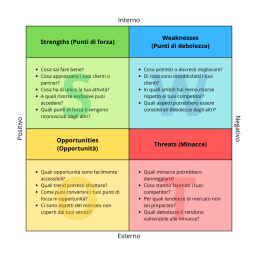
SWOT analysis evaluates the internal (strengths and weaknesses) and external (opportunities and threats) factors of a business. The results are reported in a matrix, which allows appropriate strategies to be developed.
Internal Factors: Strengths and Weaknesses
Strengths: These are the internal factors that give you a competitive advantage, such as brand awareness, access to resources, financial strength, and technological expertise. To identify strengths, it is useful to reflect on what you are able to do particularly well. Consider the resources at your disposal and try to identify aspects of your business that are recognised as strengths by others.
Weaknesses: these are the internal obstacles that limit the business, such as reduced financial or technological capacity, low brand awareness and lack of loyal customers. To identify weaknesses, you should ask yourself what could be improved within your business. Consider in which aspects you are investing the least resources and recognise what your weaknesses are in the eyes of others.
External Factors: Opportunities and Threats
Opportunities: These are the external factors that, if exploited correctly, can give you a competitive advantage, such as new market trends or the chance to increase visibility and turnover. To identify opportunities, start by looking for easily achievable possibilities in your industry. Look for new market trends that could be exploited to your advantage. It is also crucial to understand how to turn your strengths into real growth opportunities.
Threats: These are the external aspects that can negatively affect the business, such as problems in the supply chain or changes in the market. To identify threats, it is essential to consider various factors that could harm your business. For example, it is useful to carefully observe competitors’ strategies and recognise internal weaknesses that could expose your business to external risks.

Create a SWOT Matrix
Even before you get started, it is important to have objective data (traffic volume, sales…) and subjective data (customer satisfaction, competitive research…). Once you have collected all the data, you can proceed to create a SWOT matrix, i.e. a table with four sections (strengths, weaknesses, opportunities and threats), and note down each point that emerged from your research. This will give you an overview of the situation with a list of potential actions to take.
Connect the dots and set priorities
Before implementing any strategy, identify the connections between the sections of the SWOT matrix. For example, strengths can be used to generate new opportunities, while specific measures can be taken to address weaknesses and prevent threats. Another crucial aspect is prioritisation, so that resources and budgets are dedicated to actions that have the greatest potential impact on business success.
In conclusion
SWOT analysis is a simple and effective tool for:
- Analysing strengths, weaknesses, opportunities and threats of your business.
- Exploit what you do well and fill gaps.
- Maximise opportunities and minimise risks.
- Devise new effective strategies and analyse competitors.
Using SWOT analysis regularly helps keep your business competitive and ready to face market challenges.
Related post

Green Commerce: calculating and communicating the ecological footprint of every order
Green commerce makes the ecological footprint of every order visible for more…

Mobile marketing: what it is and why it’s strategic
Discover why mobile marketing has become the heart of digital strategies. In…

The difference between B2B and B2C E-commerce: two worlds, two strategies
B2B and B2C are two fundamentally different e-commerce models in terms of…